
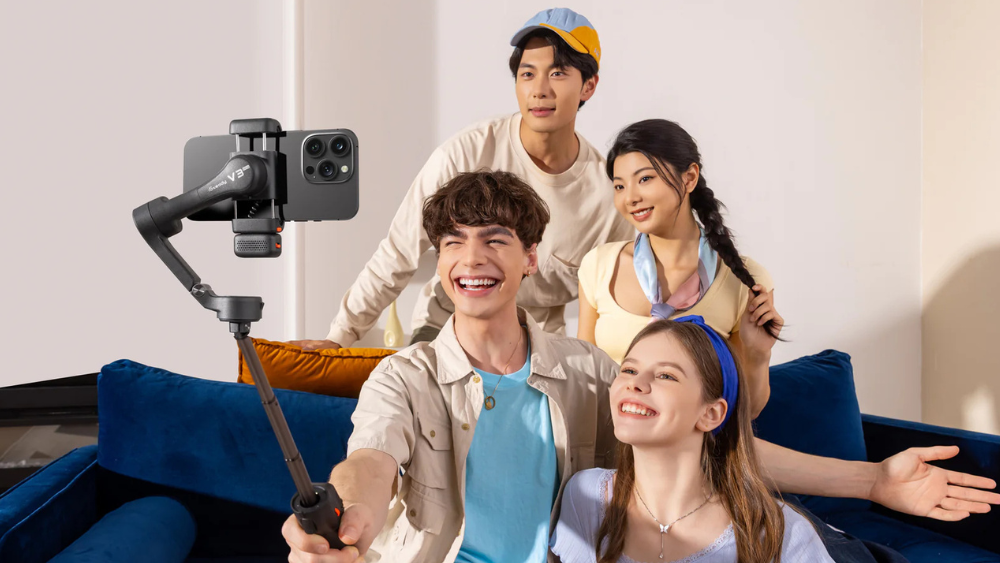
Smartphone video has evolved at an incredible pace. Today’s phones come packed with powerful AI features like computational stabilization, Action Mode, auto-framing, and subject detection. An iPhone can smooth footage, track faces, and intelligently crop a scene — all in real time.
With all this technology in our pockets, it’s fair to ask: Do we still need smartphone gimbals?
Many creators assume AI has made external stabilization tools obsolete.
The reality is more nuanced. AI video tools enhance footage after the fact, but they don’t replace physical stabilization or intentional camera movement. As creators push toward more dynamic shots, solo filming, and cinematic storytelling, modern AI tracking gimbals have become the missing link — combining software intelligence with real-world motion control.
What AI Video Stabilization Does Well
To understand why gimbals still matter, it’s important to acknowledge what AI already does well.
Computational Stabilization (OIS + EIS)
Modern smartphones use a mix of optical image stabilization (OIS) and electronic image stabilization (EIS) to reduce small hand movements. This works well for casual filming, short clips, and steady hands. The trade-off is that EIS relies heavily on digital cropping, which slightly reduces image quality.
AI Framing & Action Mode
AI framing keeps subjects centered and helps manage fast motion. Action Mode, in particular, is impressive for sports or quick movement. However, it achieves stability through aggressive cropping, often lowering resolution and creating a flatter, less cinematic look.
Where AI Alone Is “Good Enough”
AI stabilization shines in:
- Static shots
- Short, casual clips
- Bright outdoor conditions
But once you introduce movement, storytelling, or low-light filming, AI quickly reaches its limits.
Where AI Video Falls Short (And Why Creators Feel It)
Creators often notice these issues immediately:
- Walking footage still shows micro-jitters
- Low-light video becomes noisy due to aggressive digital stabilization
- AI removes motion, but not intent
- No real control over pans, tilts, or cinematic framing
AI can digitally follow a subject, but it cannot physically reframe space or change perspective. That’s where hardware makes the difference.
What Smartphone Gimbals Add That AI Cannot
Smartphone gimbals introduce hardware intelligence, stabilizing motion before software even touches the image.
True Mechanical 3-Axis Stabilization
A gimbal stabilizes movement physically across three axes:
- Less digital cropping
- Higher image quality
- Smooth walking shots, pans, and tilts
This pre-stabilization gives AI a cleaner signal to work with, resulting in better final footage.
Cinematic Camera Movement
Gimbals allow creators to intentionally move the camera:
- Parallax walking shots
- Controlled pans and tilts
- Orbit and reveal movements
- Natural depth and perspective
These are movements AI alone simply cannot create.
The Rise of AI Tracking Gimbals (The Game Changer)
This is where modern gimbals truly separate themselves from the past.
What Is AI Tracking on a Gimbal?
AI tracking gimbals use a dedicated vision sensor or AI module to detect and follow a human subject in real time. Instead of digitally cropping, the gimbal physically rotates to keep the subject framed.
Why AI Tracking Gimbals Are Different From App Tracking
Unlike app-based tracking, hardware AI tracking works across platforms, including:
- Native iPhone camera
- Blackmagic Camera
- TikTok, Instagram, Zoom, and livestream apps
There’s no software lock-in, giving creators flexibility across workflows.
Why This Matters in 2025–2026
Content creation is increasingly solo-driven. Livestream shopping, tutorials, and vertical social content require hands-free filming without losing framing. AI tracking gimbals effectively act as a virtual camera operator.
Real-World Scenarios Where AI Tracking Gimbals Shine
AI tracking gimbals are especially powerful for:
- Solo travel vloggers walking and talking
- Livestream sellers moving freely in a room
- Fitness and dance creators with constant motion
- Tutorial and education creators filming alone
- Parents and lifestyle creators capturing natural moments
In these cases, AI tracking transforms a phone and gimbal into a smart, responsive filming system.
Why Hohem Gimbals Fit the AI Video Era Perfectly
Hohem designs gimbals for creators who move — not just stand still. Their approach combines:
- Dedicated AI tracking hardware
- High payload support for modern phones and accessories
- Large tilt ranges for dynamic framing
- Physical stabilization working alongside AI intelligence
From heavy-duty setups like the iSteady M7, to everyday creator tools like the iSteady V3 Ultra, and beginner-friendly X-series models, Hohem aligns perfectly with how creators film today.
When You Can Skip a Gimbal (And When You Shouldn’t)
You can skip a gimbal if:
- You only film static tripod shots
- You create very short clips with minimal movement
You still need a gimbal if:
- You walk while filming
- You shoot in low light
- You want cinematic motion
- You film solo and need tracking
- You regularly create vertical social content
AI Video + AI Tracking Gimbals Are Better Together
AI video isn’t replacing smartphone gimbals — it’s making them more powerful. Mechanical stabilization combined with AI tracking delivers smoother motion, higher image quality, and true creative control.
Smartphone gimbals have evolved from simple accessories into essential tools for modern creators. For anyone serious about mobile video in 2025 and beyond, the future isn’t AI or gimbals — it’s both working together.
Explore Hohem’s AI tracking gimbals and elevate how you move, film, and create.
Laisser un commentaire
Tous les commentaires sont modérés avant d'être publiés.
Ce site est protégé par hCaptcha, et la Politique de confidentialité et les Conditions de service de hCaptcha s’appliquent.