
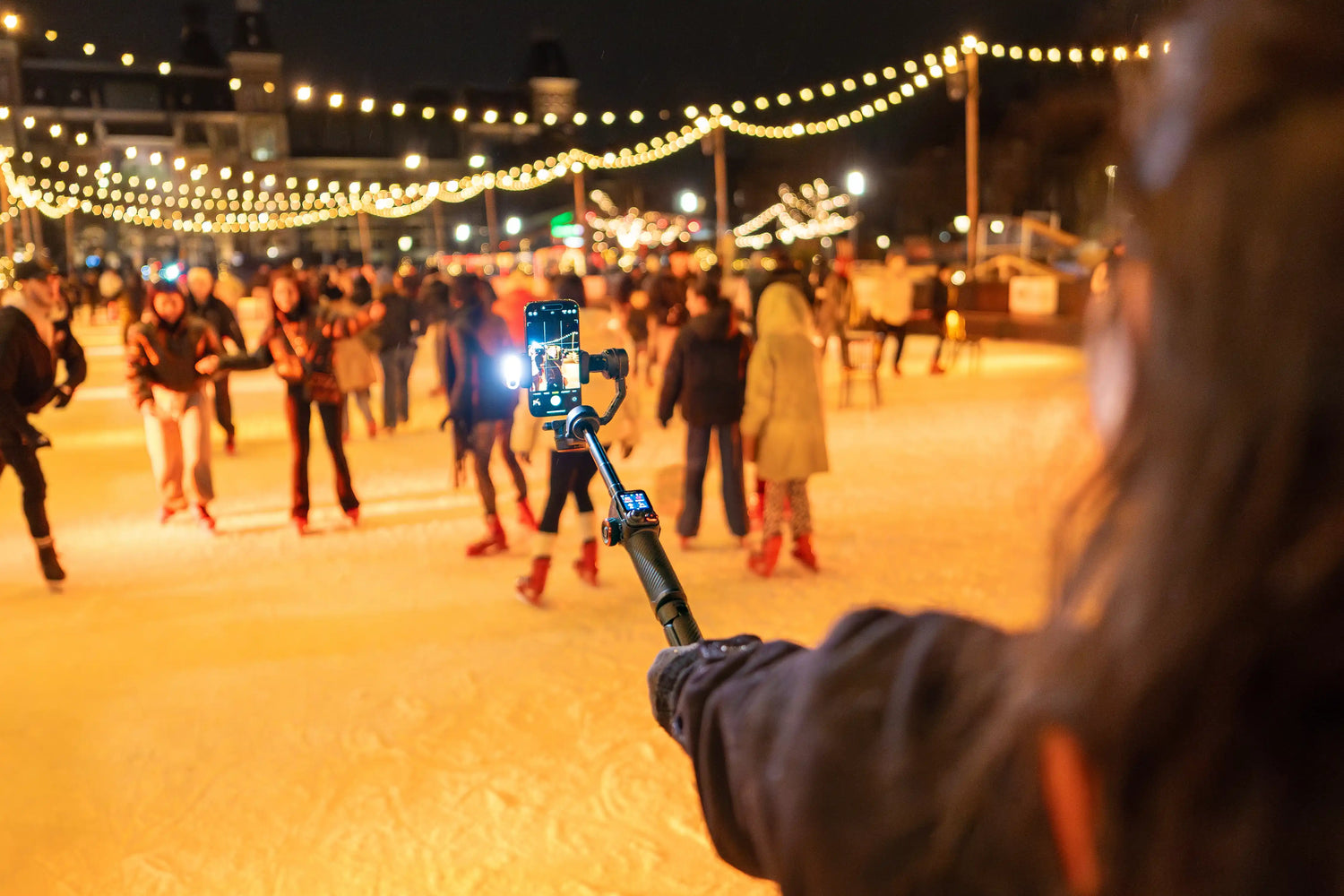
If you are a solo creator looking for smooth, professional video, you have probably weighed the same two options: buy a dedicated pocket gimbal camera for $500 or more, or find a way to get better results from the smartphone you already carry.
For years, pocket cameras had a genuine edge in portability and stabilization. But the gap has closed rapidly. Flagship smartphones now shoot 4K ProRes video with computational HDR, optical zoom, and low-light capability that matches or exceeds most pocket cameras in the sub-$600 range. The camera in your pocket is no longer the weak link. Stabilization and workflow are.
That is exactly the problem the Hohem iSteady M7 was built to solve. It pairs with the phone you already own and adds 3-axis mechanical stabilization, on-device AI tracking, a detachable remote with a live video feed, and built-in fill lighting. The result is a solo creator setup that outperforms most pocket cameras in the areas that matter most: framing control, tracking versatility, lighting, and long-term value.
Here is how the two approaches compare, feature by feature.
Your Phone Is Already a Better Camera Than Most Pocket Devices
Before comparing stabilization tools, it is worth acknowledging what your phone brings to the table. The iPhone 17 Pro Max, Samsung Galaxy S26 Ultra, and Google Pixel 10 Pro all feature large sensors, periscope telephoto lenses, advanced computational night modes, and pro-level video recording capabilities. These are not incremental improvements over pocket cameras. In many cases, they are outright better.
When you buy a standalone pocket camera, you are paying for a sensor and a lens. You already own both of those. What you actually need is a way to unlock the full potential of the camera you have already paid for. A professional smartphone gimbal like the iSteady M7 does exactly that, without duplicating hardware you do not need.
4 Areas Where the iSteady M7 Setup Outperforms Pocket Cameras
1. Detachable Touchscreen Remote for Solo Framing
One of the biggest pain points with pocket cameras is framing yourself from a distance. Most pocket cameras have a 2-inch fixed screen that is nearly impossible to see from more than a few feet away. If you are filming a talking-head video, a product demo, or any scenario where the camera is on a tripod and you are in front of it, you are essentially guessing at your framing.
The iSteady M7 solves this with a detachable touchscreen remote control. You can set your phone up on a tripod, walk up to 10 meters away, and see your live shot directly on the remote's 1.4-inch full-color screen. From the remote, you can double-tap to select any tracking target (yourself, a pet, a product, or any moving object), and the gimbal's AI will lock on and follow. For solo creators, this is the equivalent of having a camera operator in your hand. If you want to learn more about hands-free solo filming techniques, we covered the full workflow in a separate guide.
Pocket cameras have no comparable feature. Their screens are fixed to the camera body, and their tracking systems (when they exist at all) only work within the camera's own native app.
2. A 500g Payload That Grows with Your Gear
When you buy a pocket camera, what you get is what you are stuck with. You have one fixed focal length, and digital zoom degrades image quality quickly. You cannot mount external lenses, professional ND filters, or pro-grade mobile microphones. The camera is a closed system.
The iSteady M7 takes the opposite approach with an industry-leading 500g (1.1 lbs) payload capacity. It handles the largest flagship phones, including foldable devices, and supports external accessories mounted to the phone: anamorphic lenses, telephoto attachments, polarizer filters, and clip-on microphones. Your phone is already a modular system, and the M7 is built to stabilize whatever you attach to it.
The other advantage is future-proofing. Smartphone cameras improve every year. When you upgrade your phone, your entire camera system upgrades with it, and the M7 is ready to stabilize the new device immediately. A pocket camera, by contrast, is typically outdated within two to three years. If you are weighing the M7 against other smartphone gimbals, the 500g payload is one of the highest in its class.
3. App-Free AI Tracking and Magnetic RGB Fill Lighting
Most pocket cameras offer some form of built-in tracking, but it only works within the camera's native recording app. The moment you switch to a live stream on TikTok, a FaceTime call, or a third-party camera app, the tracking stops working entirely. This limits the practical usefulness of the feature to a single workflow.
The M7's AI tracking works independently of any app because it runs on the gimbal's own hardware, not your phone's software. Whether you are recording in the native iPhone camera app, streaming live on Instagram, filming a tutorial for YouTube, or capturing content in a third-party video app, the gimbal tracks your subject with the same precision. The tracking sensor recognizes faces, bodies, pets, products, and other objects. You can learn more about how gimbal-based AI tracking compares to phone-based stabilization in our comparison guide.
The magnetic AI tracker module also doubles as an adjustable RGB and CCT fill light. You can dial in warm, cool, or neutral white tones across a 2700K to 6500K range, or switch to full RGB for creative color effects. This eliminates the need for a separate portable light, which is one less piece of gear to carry and one less thing to charge. Pocket cameras offer no native fill lighting at all.
4. Built-In Extension Rod and Reverse Charging
Getting a high overhead angle or a dramatic low-angle tracking shot with a pocket camera usually means buying and attaching an external extension rod. It is an extra accessory, an extra cost, and an extra step in your setup workflow.
The M7 has a built-in 193mm (8-inch) extension rod that pulls out instantly. Extend it upward for overhead angles that mimic drone-like perspectives, or extend it downward for low-angle push shots that add dramatic scale. For more ideas on how to use these angles, our cinematic B-roll shot guide covers 10 specific techniques you can execute with a gimbal and a phone.
Battery life is the other practical advantage. The M7 packs a 3200mAh battery that delivers up to 12 hours of continuous use on a single charge. That is enough for an entire day of shooting without interruption. It also supports reverse charging, meaning the gimbal can charge your phone while you film. If you have ever had a pocket camera die mid-shoot with no way to charge it without stopping, you understand why this matters.
Comparison at a Glance: iSteady M7 vs Pocket Cameras
|
Feature |
Hohem iSteady M7 + Phone |
Standalone Pocket Camera |
|
Monitor Screen |
Full phone screen (6"+) plus detachable remote with live feed |
Built-in 2" fixed screen |
|
Sharing Workflow |
Instant: edit and post directly from phone |
Requires file transfer via Wi-Fi, cable, or app |
|
Tracking Versatility |
Works across all apps: TikTok, Instagram, Zoom, native camera |
Limited to built-in camera app only |
|
Hardware Longevity |
Camera upgrades with every new phone |
Fixed hardware, typically outdated in 2-3 years |
|
Fill Lighting |
Built-in magnetic RGB and CCT fill light |
None (requires external accessories) |
|
Lens Flexibility |
Phone's native lenses plus external attachments |
Fixed focal length, digital zoom only |
|
Extension Rod |
Built-in 193mm retractable rod |
Requires separate accessory |
|
Battery Life |
12 hours + reverse charging for phone |
Varies (typically 2-4 hours) |
The Cost Comparison: Smart Investment vs Hidden Costs
A premium pocket camera bundle typically costs between $400 and $600. That price buys you a fixed camera system with a predetermined sensor, a single focal length, and built-in stabilization that works only within the device's own software. When the internal battery degrades, the lens gets scratched, or the sensor falls behind the current generation, the entire unit needs to be replaced.
The Hohem iSteady M7 costs a fraction of that and delivers a modular setup that improves over time rather than declining. Your camera system upgrades whenever you get a new phone. Your stabilization, tracking, lighting, and remote monitoring remain constant. The gimbal itself is the durable backbone of a kit that evolves with you.
For creators who also shoot on mirrorless cameras, Hohem offers the iSteady MT3 Pro, which supports camera rigs up to 2.5kg. We covered the differences between the two models in our MT3 Pro vs M7 comparison guide.
Who Should Still Consider a Pocket Camera?
To be fair, pocket cameras are not without merit. There are a few specific scenarios where a dedicated device still makes sense.
If you need a truly pocketable one-piece device. A pocket camera is a single unit with no setup required. You pull it out, hit record, and put it back. If your priority is absolute minimum setup time and you do not need AI tracking, fill lighting, or remote framing, a pocket camera offers that simplicity.
If you want a dedicated camera for rough conditions. Some creators prefer not to risk their phone in extreme sports, water, or dusty environments. A pocket camera serves as a separate, expendable recording device in these cases.
If your phone is older than 2022. The M7 setup assumes you are working with a reasonably capable phone camera. If your phone is several generations old with a dated sensor and lens system, the advantages of gimbal stabilization are still significant, but the baseline video quality may not match a dedicated pocket camera.
For everyone else, particularly solo creators, vloggers, live streamers, and mobile filmmakers working with a 2023 or newer flagship phone, the M7 paired with your existing phone is the stronger investment in both capability and long-term value.
Turn the phone you already own into a professional filmmaking rig. Explore the Hohem iSteady M7 and see what your smartphone can really do with the right stabilizer.
Leave A Comment
All comments are moderated before being published.
Ezt a webhelyet a hCaptcha rendszer védi, és a hCaptcha adatvédelmi szabályzata, valamint szolgáltatási feltételei vonatkoznak rá.