
Choosing the Right Gimbal for Your Setup
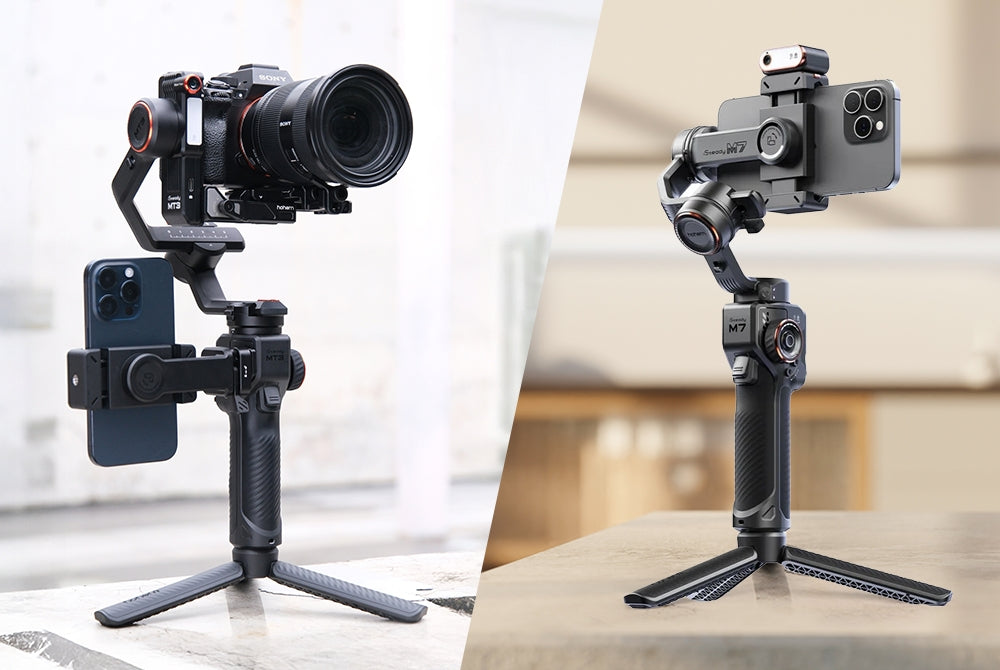
When you're trying to decide between two powerful gimbals, it's not always easy to rely on the specs. The Hohem iSteady MT3 Pro and the Hohem iSteady M7 both have impressive specs. But in practice they are designed for two very different types of users.
One is for creators who are looking for a more professional camera setup. The other is made for creators who want to use a smartphone setup to its full potential without the need for complexity. That's why the "better" option is not the most capable model. It is about which one suits your shooting style.
In this guide, we will break down the difference between the Hohem iSteady M7 and the Hohem iSteady MT3 Pro in a simple, practical way so you can decide with confidence. If you want to explore the full Hohem lineup first, you can also browse the main Hohem store.
Quick Answer: MT3 Pro or M7?
We want to give a fast, scannable answer to provide immediate value and reduce bounce rates. For clarity, here is how they break down:
|
MT3 Pro |
iSteady M7 |
|
Built for Mirrorless / DSLR users. |
Ideal for smartphone creators. |
|
Offers a long-term upgrade path. |
Supports heavy phone users. |
|
Designed for multi-device creators. |
Prioritizes simplicity and portability. |
That is the short version. Now let’s look at who each gimbal is really built for.
Who the Hohem iSteady MT3 Pro Is Best For

If you are looking for the best DSLR gimbal , a reliable gimbal for DSLR , a heavy-duty camera stabilizer, or professional gimbals, the Hohem iSteady MT3 Pro is your answer. We position this as a pro-level upgrade tool.
That's largely because of weight. At 2.5 kg, the MT3 Pro is capable of carrying more heavy gear. This is important because once you start using interchangeable lens cameras, your requirements change. You are no longer supporting only the weight of the camera body. You are also potentially holding a larger lens, accounting for the change of field of view, and considering framing more thoughtfully.
The MT3 Pro is also 4-in-1 compatible. This can be a benefit if you are someone who doesn't want something that will limit you in a few months time. If you need to work with other devices, or may need to in the future, flexibility is more important than you might think.
The other key benefit is vertical shooting. Vertical is not a niche. Vertical is the format for many creators and brands. The MT3 Pro offers a way to transition between more traditional camera shots and social-friendly content without compromise.
And then there's expandability. The ability to connect to accessories like a focusing motor makes it feel like more than a toy. This is why the MT3 Pro is for people looking for the best DSLR gimbal, a reliable gimbal for DSLR, or gimbals suitable for commercial use.
In short, the MT3 Pro is for those who want more than the convenience of a gimbal but the flexibility of a camera system.
Who the Hohem iSteady M7 Is Best For

For those searching for the best smartphone gimbal, we position the Hohem iSteady M7 as a mobile-first powerhouse.
It's all about phone content creation for the M7. A key aspect of that is the AI tracking that doesn't require an app. For single-person creators, it's a big deal to be able to stay in the camera without having to set up complicated rigs. It eliminates barriers, which are often the biggest problems.
The extension pole is also a valuable feature. It allows creators to shoot with a wider field of view, from above, with a selfie-style talking head style, or with more varied angles, without the need for additional equipment. For creators travelling, vlogging, and shooting a range of content for social media, that's a huge deal.
Two-way charging is another convenience. Filming can be hard on a phone battery, especially when streaming live, shooting for long periods, or shooting on the road. Power support gives creators more confidence when working in the field, rather than in the studio or on set.
If you want the best smartphone gimbal for a workflow built around speed, portability, and direct-to-platform content, the Hohem iSteady M7 is the more natural fit.
Feature Comparison: MT3 Pro vs M7
The easiest way to compare these two models is to stop asking which one has better specs overall and start asking what those specs help you do.
|
The MT3 Pro gives you |
The M7 gives you |
|
A much higher payload for mirrorless and DSLR setups |
Strong support for heavier smartphones |
|
More flexibility for creators using multiple device types |
App-free AI tracking for easier solo shooting |
|
Vertical shooting support for social formats |
Reverse charging for longer content sessions |
|
Room to expand with accessories like a focus motor |
A built-in extension pole for more flexible angles |
So the comparison is not really camera gimbal versus phone gimbal in a simple way. It is more about production style. The MT3 Pro supports a broader, more gear-driven workflow. The M7 supports a faster, leaner, more immediate one.
MT3 Pro vs M7 for Different Creator Types
This section is the conversion driver and the most important part of our guide. This is where users decide.
Travel vloggers
Travel vloggers or vloggers need mobility, speed and versatility. If you primarily shoot with your phone, need to be on the move and travel through airports, cafes, streets and sightseeing locations, then the M7 is the most common choice. It's more lightweight, quicker to set up, and more suitable for casual but stylish travel videos.
If you create more film-style travel content, and you already own a mirrorless camera, the MT3 Pro is more interesting. It requires more from you, but it rewards you with enhanced control and visual quality.
Filmmakers and mirrorless users
This one is simple. The MT3 Pro is for you if you've got a mirrorless or DSLR. It is designed for that type of filmmaker and has a higher weight limit and is more versatile.
The M7 isn't a camera stabilizer. It is made to enhance, simplify, and enable smartphone video creation.
Social media creators
If you are a creator producing short-form video, talking head, tutorial, lifestyle, or day-in-the-life videos, the M7 is likely a better option. You can be fast, mobile, and use tools such as AI tracking and the integrated extension pole without any fuss.
This is particularly true if you plan on posting directly to TikTok, Instagram Reels, or YouTube Shorts.
Hybrid creators
Hybrid creators are the most interesting category because they can be found in both camps. If you mostly shoot with a phone, but are planning on switching to a camera soon, it may be worth investing in an MT3 Pro. If you already have a camera but take the majority of your content on your phone, then it might depend on which device you publish the most content with in a typical week.
A good rule is this: choose the tool that fits your primary workflow, not the one that only fits your future ambitions.
Which One Offers Better Long-Term Value?
This is where buyers sometimes get stuck. They assume value means getting the most features or the most professional option. In reality, value is about how well a tool serves the way you work.
The MT3 Pro offers better long-term value for creators who are building toward a more advanced setup. If your content goals include mirrorless shooting, cinematic footage, more lens options, and a more expandable rig, then buying a gimbal that supports that growth makes sense.
The M7 offers better long-term value for creators who are committed to a smartphone-based workflow. A lot of modern creators, and even many successful businesses, do not need a larger camera setup to produce effective content. If your phone is your main creative tool, the M7 gives you exactly what improves that workflow most.
In other words, long-term value is not about buying the more advanced product. It is about buying the product you will actually use well for the longest time.
Final Verdict: Which Gimbal Should You Choose?
Choose the Hohem iSteady MT3 Pro if you want a serious camera stabilizer for mirrorless or DSLR shooting, more flexibility, and a better upgrade path into advanced production.
Choose the Hohem iSteady M7 if you want the best smartphone gimbal for solo shooting, mobile content, social media, and fast creator workflows.
Both are strong choices. The wrong move is only choosing based on broad spec comparisons without thinking about what you actually shoot.
Conclusion: Choose Based on Your Workflow
There is no one-size-fits-all answer here, and that is a good thing. A great gimbal should fit your workflow, not force you to change it.
If your content life revolves around a phone, the Hohem iSteady M7 is likely the smarter choice. If your work is moving toward a more advanced camera setup, the Hohem iSteady MT3 Pro is built for that next step.
Either way, the best decision is the one that matches what you shoot, how you shoot, and where you want your content to go next. You can explore both options, along with the rest of the lineup, on the Hohem store.


Hinterlasse einen Kommentar
Alle Kommentare werden vor der Veröffentlichung geprüft.
Diese Website ist durch hCaptcha geschützt und es gelten die allgemeinen Geschäftsbedingungen und Datenschutzbestimmungen von hCaptcha.